.jpg)
Inside a Parent-Accompanied Heguru Class for Babies and Toddlers (6 Months to 4 Years Old): Experience & Review

Updated: Sep 23
A room full of babies and toddlers can look wonderfully unpredictable. One child claps to a song, another watches a flashcard with full attention, and another needs a cuddle before joining in again. In a Heguru class, that energy is expected. The lesson is designed around short, fast, varied activities that meet young children where they are.
For parents exploring early childhood education in Singapore, Heguru Education Centre Singapore is often part of the conversation because its classes focus on whole-brain development from the earliest years. A Heguru baby enrichment class is not a sit-still academic lesson. It is a guided learning experience that uses rhythm, memory, visual stimulation, language, and parent-child participation to build attention and confidence over time.
What Happens in a Heguru Brain Training Enrichment Class for Babies and Toddlers
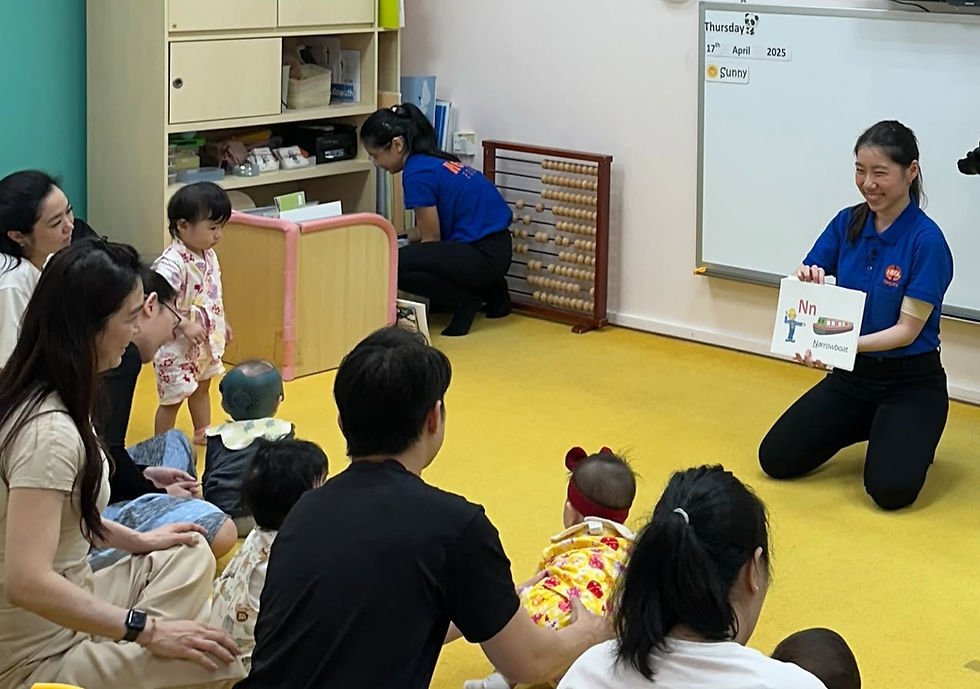
The class moves quickly on purpose
One of the first things parents notice is the pace. Activities change often, sometimes after just a short burst of attention. This is not random. Babies and toddlers learn through repeated exposure, sound, movement, and strong emotional connection.
A typical Heguru lesson may include:
High-speed flashcards with pictures, words, numbers, and patterns
Songs, chants, and rhythm-based activities
Memory games using cards, objects, or sequences
Number and quantity activities
Simple puzzles, matching tasks, and visual recognition
Imagination or visualisation prompts
Fine motor tasks such as placing, sorting, or pointing
Parent-child response activities
The fast pace helps keep young children engaged before fatigue sets in. It also exposes them to a wide range of information without pressure to “perform” immediately.
Parents who are new to this style sometimes wonder if their child is absorbing anything. Educators often explain that early learning is not always visible on the spot. A child may look away during class, then recognise a song, word, or pattern at home days later.
To understand the programme options by age, parents can start with the Heguru Education programmes page.
The key techniques behind the activities
Heguru’s approach is often described as whole-brain training, with a strong focus on early memory, concentration, and intuitive thinking. In practice, that means the class is built around several learning techniques.
Flashcard exposure
Flashcards are usually shown at speed. The goal is not to test a baby like an older student. It is to give the brain rich visual and language input. Young children hear words, see images, and begin building mental links.
Repetition with variation
A familiar rhythm may return each week, but with different words, pictures, numbers, or themes. This gives children a sense of safety while keeping the brain alert.
Multi-sensory learning
Toddlers learn best when they can see, hear, touch, and move. A class may combine a spoken word, a picture, a clap, and a physical action. This helps children connect learning with experience.
Parent-guided participation
For babies and younger toddlers, the parent is part of the activity. The adult models attention, encourages responses, and helps the child regulate emotions. This can make the class feel less like a lesson and more like shared play with structure.

How it may support cognitive development
The cognitive benefits of a brain training enrichment class for baby and toddler learners come from repeated practice in attention, memory, and pattern recognition.
A child may practise looking at a card, listening for a sound, waiting for a cue, and responding with a gesture. These are small actions, but they build important foundations for later learning.
Common areas of growth include:
Attention span
Short tasks help children practise focusing for brief periods. Over time, many children can stay with an activity for longer.
Memory
Songs, picture sequences, matching games, and repeated class routines give children chances to remember and anticipate what comes next.
Language exposure
Babies and toddlers hear words in a lively setting. They may not repeat them immediately, but the exposure supports vocabulary growth.
Visual processing
Fast-moving cards, shapes, and patterns train children to notice details and differences.
Early numeracy
Quantity, counting, dot cards, and pattern activities introduce mathematical thinking before formal sums begin.
This does not mean every child will respond in the same way. Development is uneven in the early years. Some children are vocal, while others are quiet observers. A thoughtful class allows both types of learners to take part.
Social and emotional growth matters too
Parents may sign up for enrichment because of cognitive goals, but many stay because they notice changes in confidence and social comfort.
In a class setting, babies and toddlers learn to share space with other children. They hear group instructions, watch peers, take turns in simple ways, and experience a predictable routine outside the home.
For toddlers, this can be especially valuable. A child who struggles with transitions may slowly learn that a class has a beginning, middle, and end. A child who is shy may begin by sitting quietly, then later point, clap, or answer.
Educators often look for small signs of readiness:
A child turns towards the teacher’s voice
A child imitates a clap or action
A child recognises a familiar song
A child waits briefly before touching a material
A child recovers faster after feeling upset
These moments may look simple, but they support self-regulation, confidence, and social awareness.

What parents and educators often notice
A balanced Heguru review usually includes both excitement and realism. Some parents report that their child becomes more responsive to songs, pictures, and memory games at home. Others notice better sitting tolerance or more confidence in group settings.
One parent insight commonly shared after early lessons is that progress appears in everyday moments. A toddler may suddenly name an object from class, complete a familiar action song, or show interest in books for longer than before.
Educators tend to remind families that consistency matters. One lesson can be fun, but the benefits usually come from repeated exposure and a calm home environment that supports curiosity. They may also encourage parents not to compare children. A quiet child may still be learning deeply.
For families trying to recommend enrichment class for young children within their own circles, the most useful advice is to observe fit. The pace, teaching style, and parent involvement should suit the child’s temperament as well as the family’s goals.
Parents who want to learn more about how Heguru classes can benefit their babies or children can visit the Heguru Education Introduction page or hear directly from families who have attended Heguru lessons through their real reviews and personal experiences of Heguru.

The takeaway for parents
A Heguru class for babies and toddlers is active, fast, and highly guided. It blends flashcards, songs, memory work, movement, sensory play, and parent participation into a structured session for early development.
The strongest value is not only in early academic exposure. It is also in helping children practise attention, confidence, emotional recovery, and social participation in a warm group setting.
For parents exploring enrichment in Singapore, the best next step is to observe how the class feels for the child. A good early learning experience should stretch young minds while still feeling safe, joyful, and connected.

Comments